
Feedback Delay Networks for Artificial Reverberation
 Jeremy Bai
 Gloria dal Santo
 Benoit Alary
 Jon Fagerström
 Karolina Prawda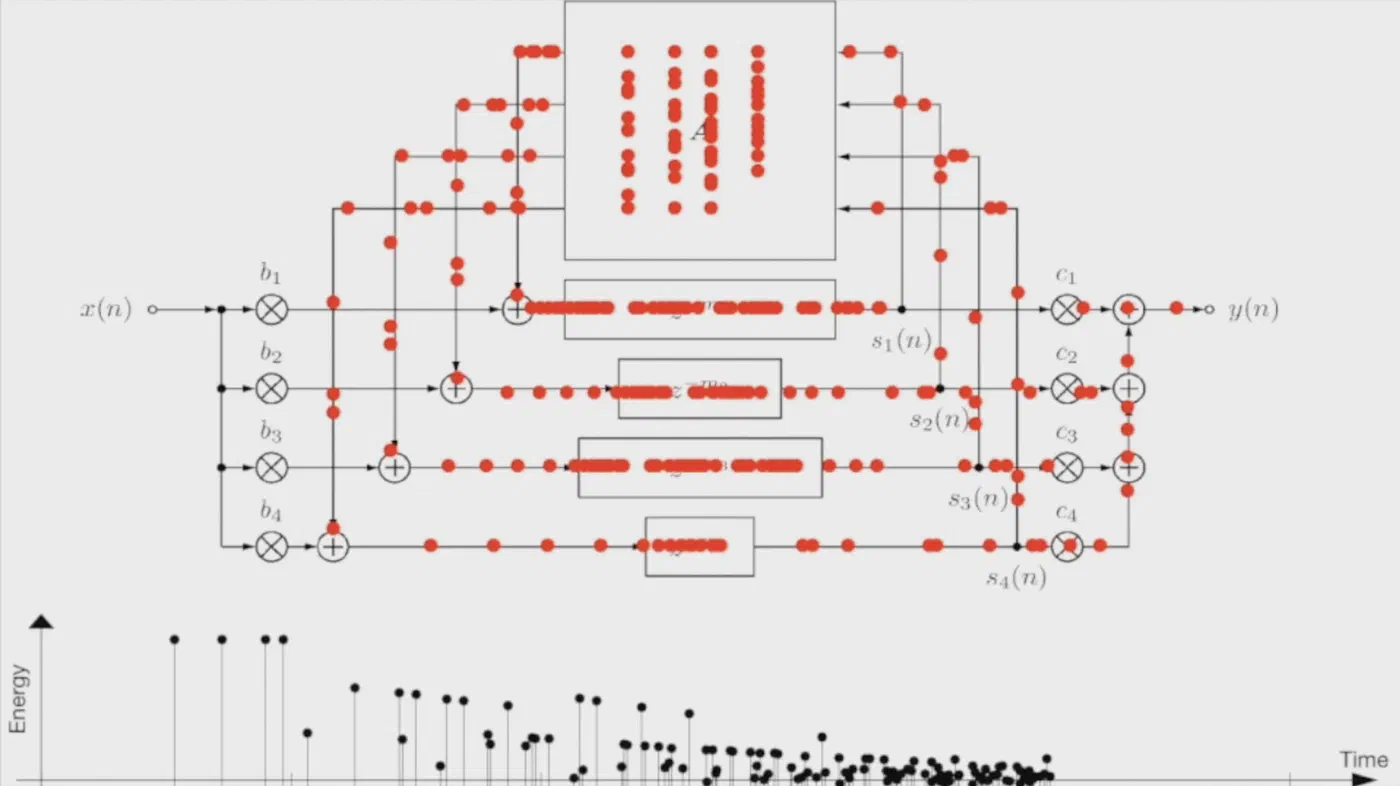
The fastest and most versatile way to add reverberation to sound.
Concept
Feedback delay networks (FDNs) are recursive filters that simulate the complex sound reflections in an acoustic space. A set of delay lines are connected through a feedback matrix, producing dense, natural-sounding reverberation from a compact set of parameters. Since their introduction, FDNs have become the standard building block for real-time artificial reverberators in games, music production, and spatial audio.
Our research pushes FDN theory and practice forward — from the mathematical foundations of lossless and allpass designs to practical tools for colorless, high-quality reverberation.
pyFDN: Python Toolbox for Feedback Delay Networks
pyFDN provides reusable building blocks for designing, simulating, and analyzing feedback delay networks in Python. It supports feedback-matrix generation, loop-filter design, pole and stability analysis, echo-density evaluation, and modular time- and frequency-domain FDN structures through FLAMO.
Documentation · Examples · PyPI
Lossless & Allpass Design
We established the necessary and sufficient conditions for lossless FDNs[1] and extended these results to allpass feedback delay networks[2], enabling precise spectral shaping of the reverb tail. Frequency-dependent Schroeder allpass filters[3] add further control over the spectral envelope of the reverberation.
Code: fdnToolbox — comprehensive MATLAB toolbox for FDN design and analysis, released under GNU-GPL 3.0.
Echo Density & Mixing Time
How quickly does an FDN build up a diffuse sound field? We developed the analytical characterization of echo density and mixing time in FDNs[4], a critical perceptual factor for natural-sounding reverberation. This work enables designers to predict and control the perceptual onset of diffuseness.
Scattering & Delay Feedback Matrices
Extending FDNs with scattering junctions[5] and delay-embedded feedback matrices[6] yields denser and more physically motivated reflections. These architectures bridge the gap between abstract delay networks and physical models of wave propagation.
Demo: Dense reverberation with delay feedback matrices — interactive listening examples from the delay feedback matrix framework.
Decorrelation
Maximizing output signal decorrelation[7] is essential for spatial audio and multichannel reverb rendering. Our analysis provides design guidelines for feedback matrices that produce uncorrelated output channels, directly applicable to surround and immersive audio production.
Code: fdnDecorrelation — implementation of decorrelation analysis for FDNs.
Modal Decomposition
We introduced a framework for decomposing FDNs into their constituent resonant modes[8], bridging the gap between delay-network and modal descriptions of room acoustics. This decomposition enables new analysis methods and connects FDN design to the physics of room resonances. Further work on modal excitation[9] reveals how input signals interact with the FDN’s resonant structure.
Code: FDNModalShapes — visualizing and sonifying modal excitation patterns in FDNs.
Grouped FDNs
Grouped FDNs with frequency-dependent coupling[10] allow richer spectral and spatial control by connecting groups of delay lines through structured feedback. This architecture enables independent tuning of different frequency bands while maintaining the computational efficiency of FDNs.
Code: Frequency-dependent GFDN — implementation by Orchisama Das.
Colorless Reverberation
Achieving a spectrally flat (“colorless”) reverb tail is a key design goal. Using differentiable signal processing, we optimize FDN parameters via gradient descent to minimize spectral coloration[11][12]. Even tiny FDN configurations can produce high-quality colorless reverberation when properly optimized.
Code: diff-fdn-colorless — differentiable optimization of FDN coloration.
Demo: Colorless FDN listening examples — audio comparisons of optimized configurations.
Velvet Noise & Non-Exponential Decay
Dark velvet noise sequences[13] extend FDNs to model non-exponential reverberation decay, capturing the complex energy envelopes found in real rooms. The binaural dark velvet noise reverberator[14] supports spatial rendering.
Code: dark-velvet-noise-reverb — an FDN-inspired reverberator using dark velvet noise sequences, with binaural support.
Demo: Binaural DVN listening examples — spatial reverb rendering demos.
Attenuation Filters
The attenuation filters in the feedback loops set the frequency-dependent decay of the reverb. A two-stage filter structure[15] — a low-order pre-filter for the overall shape, followed by an equalizer that fine-tunes the gain, for example in one-third-octave bands — matches the decay of a measured room impulse response across the full frequency range.
Code: Two_stage_filter
All group toolboxes, including pyFDN, fdnToolbox, and FLAMO, are listed under Code & Data.
References
- Sebastian J Schlecht & Emanuël A P Habets (2017). On Lossless Feedback Delay Networks. IEEE Transactions on Signal Processing.
- Sebastian J. Schlecht (2021). Allpass Feedback Delay Networks. IEEE Transactions on Signal Processing.
- Sebastian J Schlecht (2019). Frequency-Dependent Schroeder Allpass Filters. Applied Sciences.
- Sebastian J Schlecht & Emanuël A P Habets (2017). Feedback Delay Networks: Echo Density and Mixing Time. IEEE/ACM Transactions on Audio, Speech, and Language Processing.
- Sebastian J Schlecht & Emanuël A P Habets (2020). Scattering in Feedback Delay Networks. IEEE/ACM Transactions on Audio, Speech, and Language Processing.
- Sebastian J Schlecht & Emanuël A P Habets (2019). Dense Reverberation with Delay Feedback Matrices. IEEE Workshop on Applications of Signal Processing to Audio and Acoustics (WASPAA).
- Sebastian J. Schlecht, Jon Fagerström & Vesa Välimäki (2023). Decorrelation in Feedback Delay Networks. IEEE/ACM Transactions on Audio, Speech and Language Processing.
- Sebastian J Schlecht & Emanuël A P Habets (2019). Modal Decomposition of Feedback Delay Networks. IEEE Transactions on Signal Processing.
- Sebastian J. Schlecht, Matteo Scerbo, Enzo De Sena et al. (2024). Modal Excitation in Feedback Delay Networks. IEEE Signal Processing Letters.
- Orchisama Das, Sebastian J. Schlecht & Enzo De Sena (2023). Grouped Feedback Delay Networks with Frequency-Dependent Coupling. IEEE/ACM Transactions on Audio, Speech and Language Processing.
- Gloria Dal Santo, Karolina Prawda, Sebastian J. Schlecht et al. (2023). Differentiable Feedback Delay Network for Colorless Reverberation. International Conference on Digital Audio Effects (DAF 23).
- Gloria Dal Santo, Karolina Prawda, Sebastian J. Schlecht et al. (2025). Optimizing Tiny Colorless Feedback Delay Networks. EURASIP Journal on Audio, Speech, and Music Processing.
- Jon Fagerström, Sebastian J. Schlecht & Vesa Välimäki (2024). Non-Exponential Reverberation Modeling Using Dark Velvet Noise. Journal of the Audio Engineering Society.
- Jon Fagerström, Nils Meyer-Kahlen, Sebastian J. Schlecht et al. (2024). Binaural Dark-Velvet-Noise Reverberator. Proceedings of the 27-Th Int. Conf. on Digital Audio Effects (Dafx24).
- Vesa Välimäki, Karolina Prawda & Sebastian J. Schlecht (2024). Two-Stage Attenuation Filter for Artificial Reverberation. IEEE Signal Processing Letters.