Reverberation Enhancement System
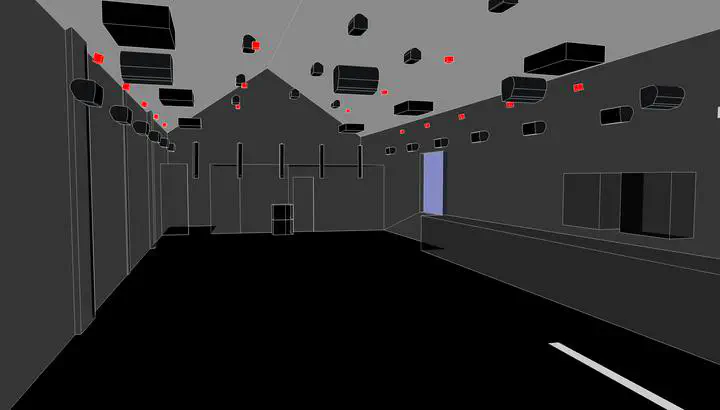
Combining digital signal processing with acoustic feedback to transform the acoustics of any space.
Concept
A reverberation enhancement system is an active system capable of controlling the room acoustics of a physical space. Microphones capture the sound present in the room, a digital signal processor enhances the signals, and loudspeakers reproduce them back into the room. This pipeline simulates changes in the geometry and absorption properties of the original space.
The video was shot in the acoustics lab Mozart at the Fraunhofer IIS, Erlangen, Germany.
Additional information regarding the specific reverberation enhancement system adopted can be found here.
Music
Beyond engineering and room acoustics, reverberation enhancement systems unlock new possibilities for artistic expression.
Corresponding author: Andrea Mancianti.
A collection of site-specific immersive sound studies for brass ensemble and live electronics, written for Öljysäiliö 468, a decommissioned oil tank in East Helsinki.
Additional information regarding the musical piece and the creative process can be found here.
Corresponding author: Eduard Tampu.
An exploration of the influence of reverberation enhancement systems in the production and performance of electroacoustic music.
Additional information regarding the study[7] that led to the creation of this musical piece can be found here.
Tools
Open-source resources to facilitate the study and the use of reverberation enhancement systems.
Time-Varying Feedback Delay Network plugin
Real-time audio plugin implementing a Time-Varying Feedback Delay Network.
This plugin is a multi-input multi-output reverberator based on a standard feedback delay network with a time-varying feedback matrix. This architecture was originally designed and proposed for reverberation enhancement systems[2]. It is built in C++ using the JUCE framework.
Setting up a reverberation enhancement system can be a challenge. DIY-RES is a guide on how to install a system using open-source software only. The proposed installation uses the Time-Varying Feedback Delay Network plugin as the system DSP.
DIY-RES offers:
Installation instructions
A written guide to setting up the transducers and using the Time-Varying Feedback Delay Network plugin in the installation.
Signal routing templates
Max/MSP and Reaper templates for routing signals from the microphones through the plugin to the loudspeakers.
Dataset for research on reverberation enhancement systems.
Measurements from rooms with installed reverberation enhancement systems have been collected in a single open database[8]. This work facilitates the study of real-world system implementations and improves result reproducibility.
Python library for reverberation enhancement system development and simulation.
PyRES is open-source software for testing digital signal processing architectures in reverberation enhancement systems[8]. It interfaces with DataRES, enabling simulation of real-world systems. Using FLAMO as a back-end enables the generation of custom-made DSPs as chains of elementary processing blocks. Each block operation is defined as differentiable, allowing each architecture to be trained in a DDSP fashion.
PyRES includes additional functionalities for visualization, evaluation, and auralization.
Publications

Gian Marco De Bortoli
Doctoral Researcher
Working on reverberation enhancement systems for music performances.
Technology for the arts.