
Generative Models for Room Impulse Responses
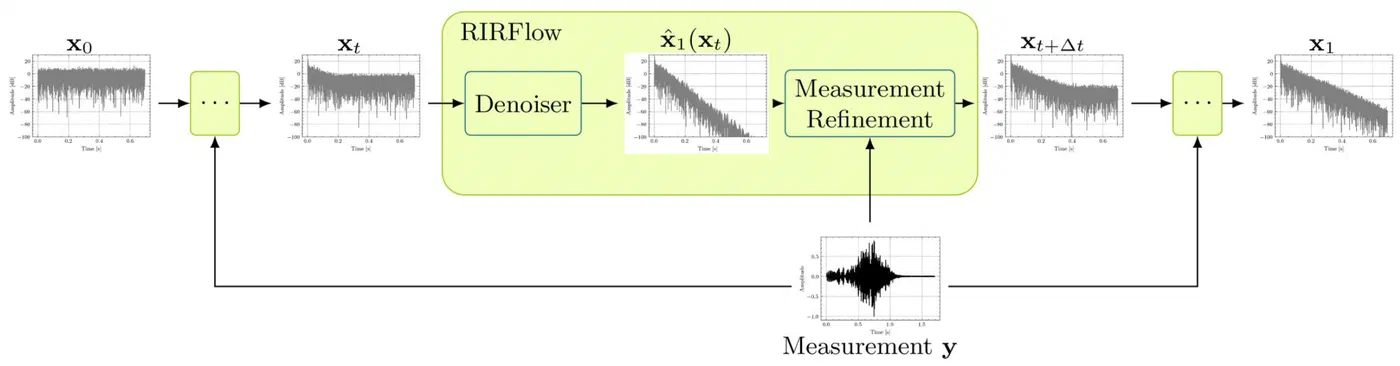
Imagine rendering the same voice in a small office, a rehearsal room, or a large hall. A room impulse response describes how sound travels from a source to a receiver and carries the acoustic signature of that space. Generating plausible responses with controllable acoustic properties is useful for audio rendering, simulation, and training signal-processing systems.
This project explores generative models for room impulse responses, connecting machine learning with room acoustics. Rather than predicting only one response, a generative model can describe a distribution of possible responses and produce different examples. Depending on the project, we may investigate learned models such as diffusion or flow matching, or combine statistical acoustic models with modern generative inference [1–3].
The challenge is to connect model behavior to acoustics: do generated responses have the intended decay and spectral characteristics, do they vary meaningfully, and do they produce convincing reverberant audio? A small numerical error alone does not settle these questions. Evaluation can combine acoustic measures, comparisons with reference data, and listening examples.
Project ideas
- Explore representations and generative models. Establish a reproducible baseline and compare ways of representing room impulse responses for generation.
- Investigate acoustic control. Study how a model can generate varied responses while respecting selected acoustic properties, and test its behavior on conditions excluded from development.
- Evaluate generated responses. Compare acoustic characteristics and rendered audio, and identify where different evaluation measures agree or disagree.
A project will address one bounded question, with a working implementation, clear baselines, and reproducible evaluation. It can be taken as a research project or as a master thesis; we agree on the specific question and scope when you start.
Prerequisites
Audio signal processing, Python, and basic knowledge of machine learning. Interest in room acoustics and generative methods; experience with PyTorch and probability is helpful.
Starting references
- [1] Ratnarajah, A., Zhang, S.-X., Yu, M., Tang, Z., Manocha, D. & Yu, D. FAST-RIR: Fast Neural Diffuse Room Impulse Response Generator. ICASSP (2022). Paper. An example of neural RIR generation conditioned on acoustic-environment parameters.
- [2] Lipman, Y., Chen, R. T. Q., Ben-Hamu, H., Nickel, M. & Le, M. Flow Matching for Generative Modeling. ICLR (2023). Paper. Background on learning continuous transformations from noise to data.
- [3] Lee, K. Y., Meyer-Kahlen, N., Välimäki, V. & Schlecht, S. J. Solving Room Impulse Response Inverse Problems Using Flow Matching with Analytic Wiener Denoiser. Journal of the Acoustical Society of America (2026). Paper. RIRFlow combines a statistical acoustic prior with generative inference for restoration; it is related work rather than a learned conditional RIR generator.
The featured figure shows RIRFlow [3]. See our Generative Models for Audio Inverse Problems research page for further context and examples.
Contact
Prof. Sebastian J. Schlecht (sebastian.schlecht@fau.de).