
Fast MIMO Room Impulse Response Measurement with Simultaneous Excitation
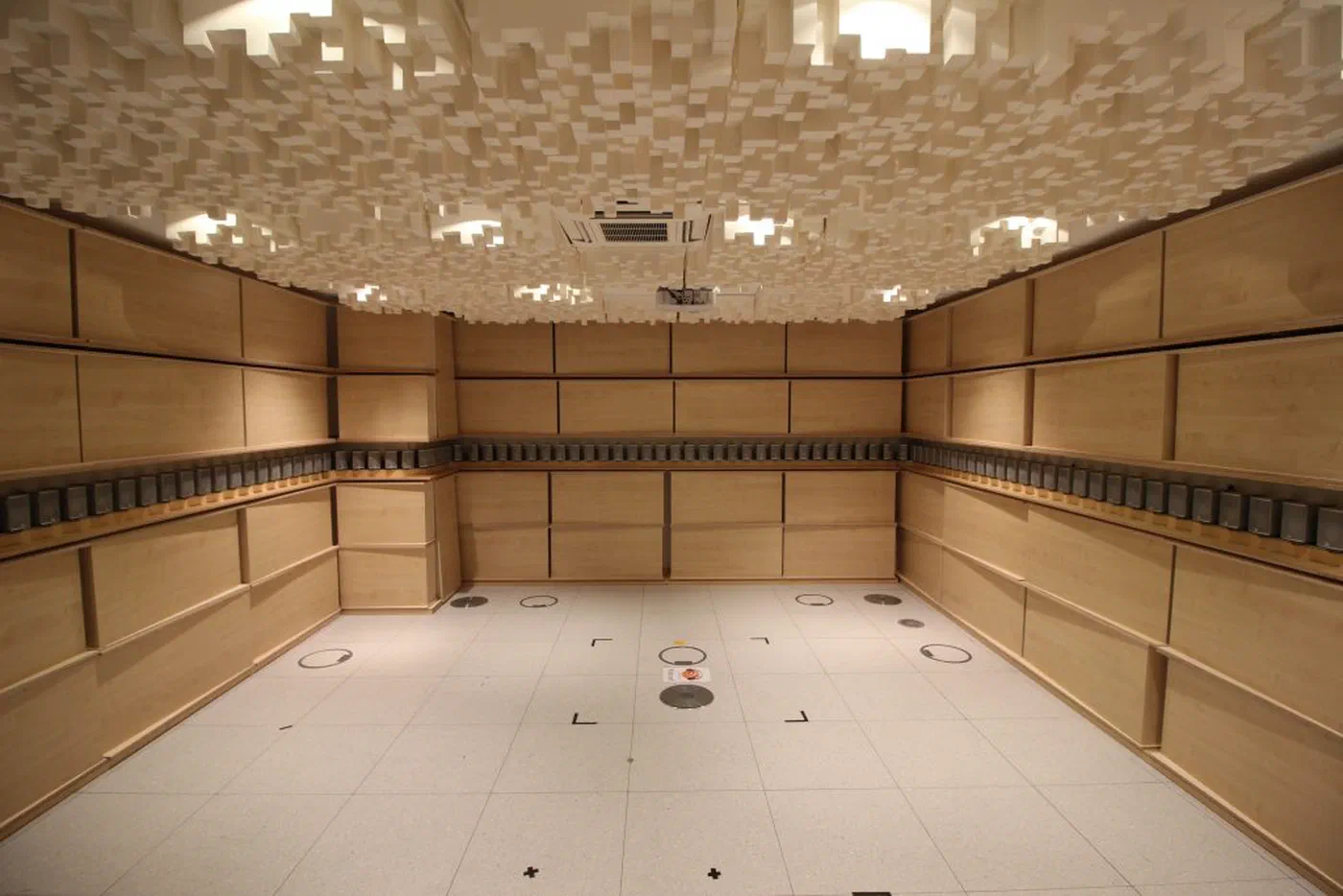
Room impulse responses (RIRs) are the basic data of room acoustics, spatial audio, and sound field control. Modern applications need them between many loudspeakers and many microphones: a multiple-input multiple-output (MIMO) system. Measured one loudspeaker at a time, this is slow. A 28-loudspeaker array rotated to 24 orientations takes about 90 minutes per position [1], and the room drifts with temperature during that time.
Several methods excite all loudspeakers at once and separate their responses afterwards: interleaved and overlapping exponential sweeps [2, 3], mutually orthogonal or shifted pseudo-random sequences [4], and sparse, convex-regularised estimation that needs fewer samples than unknowns [5]. Each trades measurement time against noise, loudspeaker non-linearity, and time variance in a different way, and they have rarely been compared on the same hardware.
The aim of this thesis is to implement these methods in a common Python framework, compare them on the large loudspeaker array in our lab, and arrive at a measurement procedure that is fast and robust in realistic conditions.
Tasks
- Review simultaneous MIMO excitation methods and formulate them as one estimation problem.
- Implement sequential sweeps (reference), multiple exponential sweeps, orthogonal sequences, and a regularised least-squares or sparse estimator.
- Evaluate in simulation and in measurements with many loudspeakers and a microphone array: system distance to the sequential reference, SNR, measurement time, and robustness to non-linear distortion, background noise, and temperature drift.
- Release the measurement code as an open-source toolbox.
Prerequisites
Digital signal processing (convolution, system identification), Python, and interest in hands-on acoustic measurements.
References
- [1] Noisternig, M. et al. High-resolution MIMO DRIR measurements in an opera hall. in Proc. DAGA (2016).
- [2] Majdak, P., Balazs, P. & Laback, B. Multiple exponential sweep method for fast measurement of head-related transfer functions. J. Audio Eng. Soc. 55, 623–637 (2007).
- [3] Dietrich, P., Masiero, B. & Vorländer, M. On the optimization of the multiple exponential sweep method. J. Audio Eng. Soc. (2013).
- [4] Antweiler, C., Telle, A. & Vary, P. NLMS-type system identification of MISO systems with shifted perfect sequences. in Proc. IWAENC (2008).
- [5] Benichoux, A., Simon, L., Vincent, E. & Gribonval, R. Convex regularizations for the simultaneous recording of room impulse responses. IEEE Trans. Signal Process. 62, 1976–1986 (2014).
Contact
Prof. Sebastian J. Schlecht (sebastian.schlecht@fau.de).