
Reverberation Enhancement for Small Rehearsal Spaces
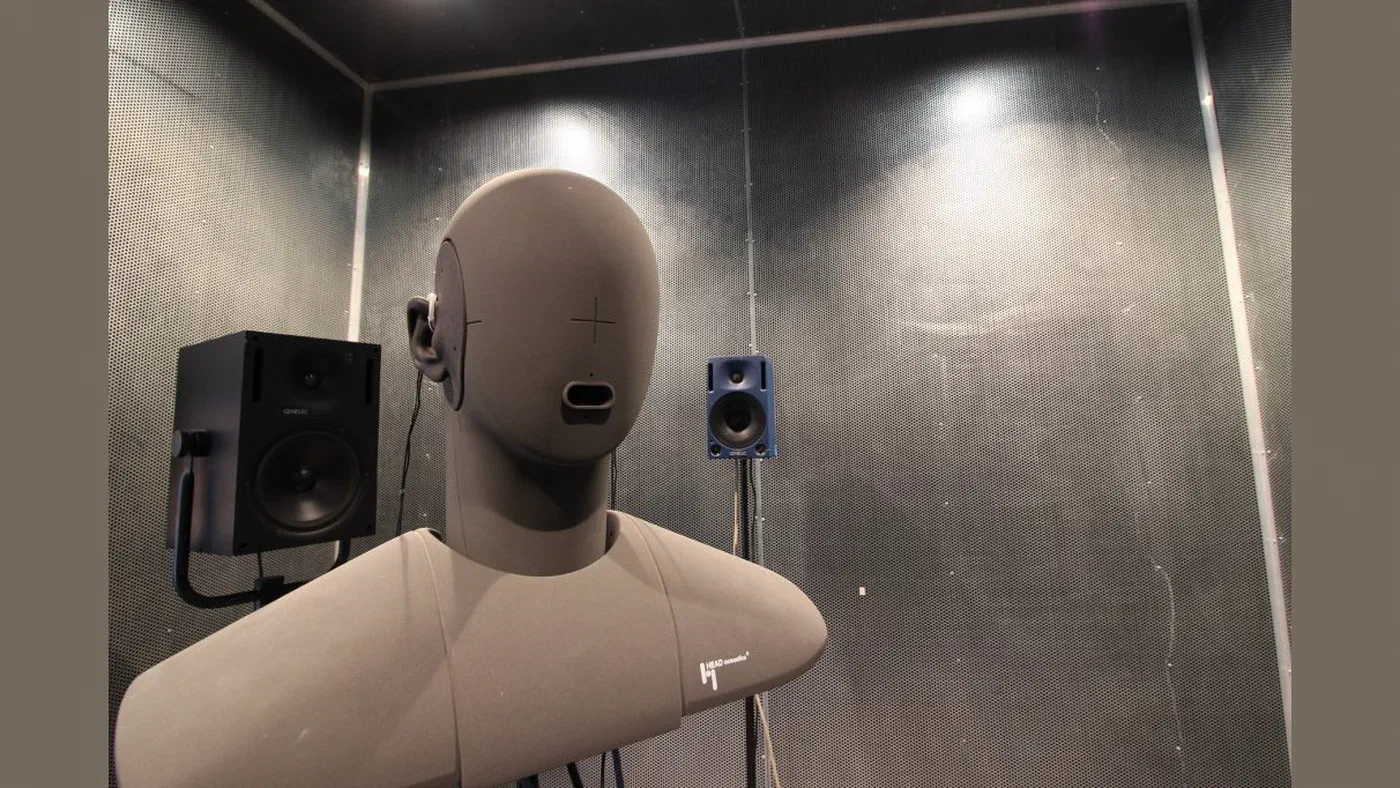
Reverberation enhancement systems (RES) use microphones, loudspeakers and real-time processing to change how a room sounds: a dry rehearsal room can sound like a church or a concert hall at the push of a button. Today these systems are installed in large venues and tuned by hand by an acoustician. Musicians, however, spend most of their time in small practice and rehearsal rooms of 6 to 35 m², where such a system would be most useful and where hand-tuning by an expert is too expensive.
Small rooms are not just scaled-down halls. There are few room modes, the musician sits inside the feedback loop rather than in the audience, and with only four loudspeakers the system becomes unstable (howling) with little added gain. Low frequencies are the most sensitive region. Stability, coloration and automatic tuning therefore become the core problems. For what such a system sounds like, see our reverberation enhancement demos. The research question of this thesis is whether a compact four-channel RES can tune itself in a small room: stable, uncolored and at a level musicians actually want, without an acoustician on site.
What you will do
- Build a prototype with four microphones and four loudspeakers in the LMS low-reverberation chamber (2.6 × 2.7 m, T60 ≈ 50 ms). It is the size of a small practice room, so the system has to provide the room’s reverberation itself.
- Measure and record a dataset: the system’s feedback paths, room impulse responses with the system on and off, dummy-head recordings, and recordings of acoustic instruments (e.g. acoustic guitar, violin) played through the system.
- Analyse stability and coloration with the group’s open-source tools (PyRES, differentiable optimisation of the feedback loop).
- Develop an automatic tuning procedure that sets gains, equalisation and time variation from in-situ measurements, and compare it with manual tuning.
- Evaluate with objective measures (gain before instability, reverberation time, coloration) and a small listening test with musicians.
The thesis is complete with the prototype, the dataset and an evaluated tuning procedure. The work is expected to lead to a conference paper and a public dataset.
What you bring
- Solid signal processing background (filters, feedback systems, spectral analysis)
- Python; experience with PyTorch is helpful
- Interest in room acoustics and hands-on lab work with loudspeakers and microphones
- Plus: you play an acoustic instrument
What you get
- Collaboration with an industry partner who builds active acoustic systems for concert halls and theatres
- Hands-on work in the FAU acoustic labs
- Close supervision, aiming for a joint paper
Related Work
- Cassidy, W. J., De Bortoli, G. M., Prawda, K., Coleman, P., Mason, R., Lokki, T., Schlecht, S. J., De Sena, E. (2026). Active Acoustic Enhancement Systems: A Review. J. Acoust. Soc. Am. 159(4), 3533–3557.
- De Bortoli, G. M., Prawda, K., Coleman, P., Schlecht, S. J. (2025). DataRES and PyRES: A Room Dataset and a Python Library for Reverberation Enhancement System Development, Evaluation, and Simulation. DAFx25.
- De Bortoli, G. M., Dal Santo, G., Prawda, K., Lokki, T., Välimäki, V., Schlecht, S. J. (2024). Differentiable Active Acoustics – Optimizing Stability via Gradient Descent. DAFx24.
- De Bortoli, G. M., Prawda, K., Schlecht, S. J. (2024). Active Acoustics with a Phase Cancelling Modal Reverberator. J. Audio Eng. Soc. 72, 705–715.
Contact
Prof. Sebastian J. Schlecht. Please include a short statement of interest, your CV and transcripts.