
Perceptual Sound Similarity Metrics
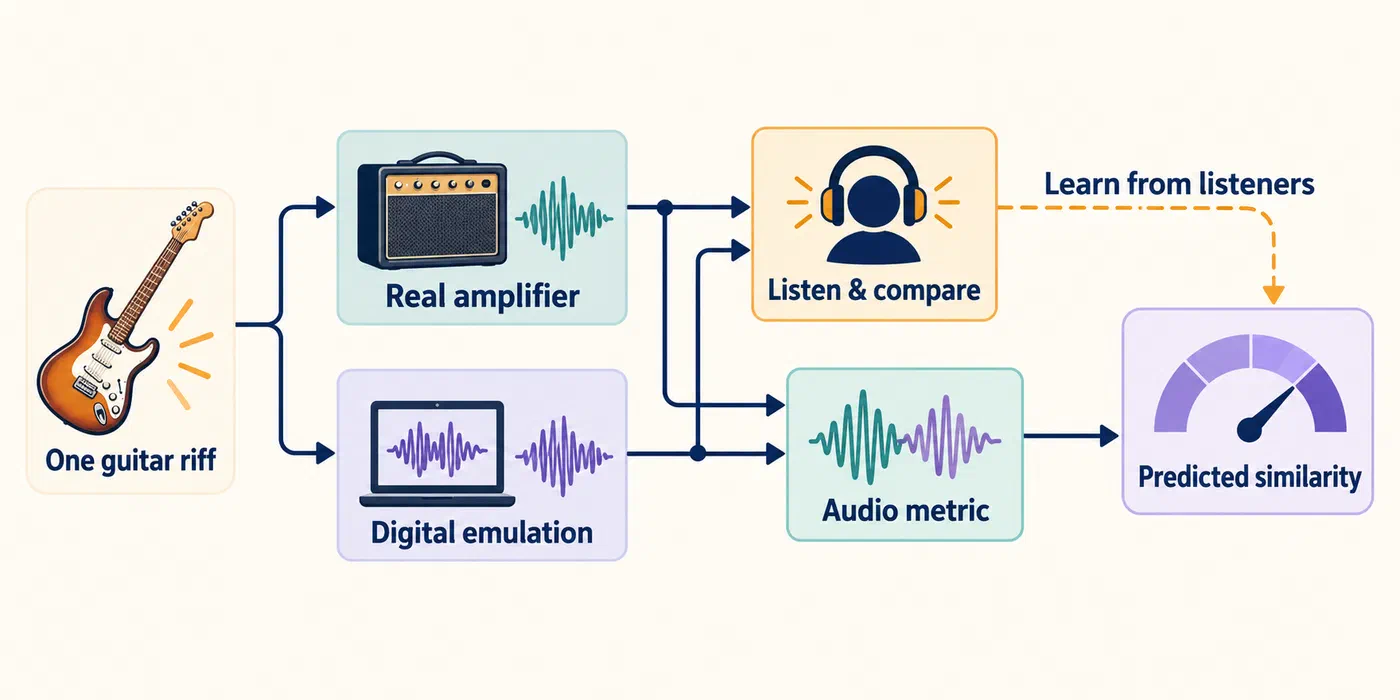
You play the same guitar riff through a real amplifier and a digital emulation. Does the emulation preserve the character of the original: the bite of the attack, the distortion texture, and the way notes decay? A waveform error gives one answer; a listener may give another. The aim of this project is to build and evaluate computational measures that capture the differences people actually hear.
Our guitar-amplifier emulation study and listening demo [1] provide a concrete starting point. The study compares reference recordings and model outputs and asks which objective metrics predict perceptual similarity. In that setting, time-frequency and learned feature distances were better aligned with listener judgments than common waveform-error measures. Try the demo: compare the reference with an emulation, then consider whether the predicted score matches your impression. The illustration above shows how listening judgments can connect an audio metric to a predicted similarity rating.
The broader question extends to audio synthesis, neural audio processing, and room acoustics. A useful metric should respond to perceptually relevant changes, tolerate irrelevant variation, and work beyond the examples used to develop it. Learning from listening evidence also raises practical questions: which judgments can be compared across studies, how much new data is needed, and which listening comparisons are most informative? Similarity, audible difference, and overall quality are related questions, but require distinct evaluation tasks.
Project ideas
- Compare metrics with listening evidence. Reproduce a baseline for a defined audio task and compare waveform, time-frequency, and learned-representation distances with listener judgments.
- Develop or adapt a perceptual metric. Investigate an audio representation or learning objective, and test it on sounds or processing methods excluded from development.
- Study efficient listening comparisons. Explore how to select informative examples and quantify uncertainty while keeping listening time manageable.
A project will address one bounded question and produce a reproducible evaluation with code, clear baselines, and listening examples. It can be taken as a research project or as a master thesis; we agree on the scope and balance of implementation, data analysis, and listening experiments when you start.
Prerequisites
Audio signal processing and programming, preferably Python. Interest in sound perception, machine learning, or experimental evaluation; experience with statistics or PyTorch is helpful.
Starting references
- [1] Wright, A., Dal Santo, G. & Schlecht, S. J. Predicting Subjective Ratings of Guitar Amplifier Emulations. Journal of the Audio Engineering Society 74(10), 762–772 (2026). Paper, listening demo, code. A concrete example of evaluating metrics against human judgments.
- [2] Manocha, P., Jin, Z., Zhang, R. & Finkelstein, A. CDPAM: Contrastive Learning for Perceptual Audio Similarity. ICASSP (2021). Paper and project. An introduction to learned perceptual distances and generalization.
- [3] See our Similarity of Sound research overview for work on reverberation, optimal transport, and spatial audio, with publications and examples.
Contact
Prof. Sebastian J. Schlecht (sebastian.schlecht@fau.de).