Virtual Acoustics Lab Course
1 Introduction
This course notebooks provide the theoretical foundation for the accompanying lab sessions. Each chapter introduces the key concepts needed for its corresponding assignment, offering a structured pathway from fundamental principles to practical implementation.
The material covers core topics in virtual acoustics, including sound propagation, spatial audio, architectural acoustics, artificial reverberation, and selected methods from machine learning. Together, these modules provide a coherent framework for understanding how sound behaves in spaces both physical and perceptually, and how these behaviors can be modeled, simulated, and analyzed.
Throughout the notebooks, you will find guidance on how to approach the learning process: where to focus conceptually, which models are essential, and how the theoretical insights connect to hands-on tasks. The goal is to equip you with the knowledge required to engage effectively with the lab work and to build a solid foundation for further study in acoustics and audio signal processing.
The python notebooks can be found at the pyfar Open Educational Resources.
1.1 Structure
There are six assignments in this course, each covering one of the following topics:
- Sound Propagation in Virtual Acoustics
- VBAP/HRTF
- Ambisonics
- Architectural Acoustics
- Artificial Reverberation
- Machine Learning for Virtual Acoustics (in development)
1.2 Acknowledgments
We would like to thank the following people for their contributions to this course:
- Cristóbal Andrade
- Nils Meyer-Kahlen
- Chris Hold
- Pedro Lladó
You can find more about our research group activities at Artificial Audio.
2 Introduction to Virtual Acoustics
2.1 What is Virtual Acoustics?
Virtual acoustics (also known as virtual reality audio, spatial audio, or 3D audio) is the field concerned with the simulation and rendering of acoustic environments using digital signal processing. The goal is to create realistic auditory experiences that accurately represent how sound propagates and interacts with the environment, ultimately delivering these sounds to a listener through headphones or loudspeakers.
Virtual acoustics encompasses several key components:
- Sound source modeling: Representing the characteristics of sound sources
- Sound propagation: Simulating how sound travels through space
- Room acoustics: Modeling reflections, reverberation, and other acoustic phenomena
- Spatial audio rendering: Delivering sound to the listener with proper spatial cues
2.2 Applications
Virtual acoustics finds applications in numerous domains:
- Virtual and Augmented Reality: Creating immersive audio experiences
- Gaming: Enhancing realism and spatial awareness
- Architectural acoustics: Predicting and designing acoustic spaces
- Telepresence: Improving communication in remote collaboration
- Training and simulation: Realistic acoustic environments for education
- Entertainment: Immersive audio for films, music, and multimedia
2.2.1 Example: Audio Presence
Audio presence refers to the sensation of being immersed within an acoustic environment, where sounds seem to originate naturally from specific directions and distances around the listener. Achieving a convincing sense of audio presence is a primary goal in virtual acoustics, as it enhances realism and user engagement in applications such as virtual reality, gaming, and telepresence.
2.2.2 Example: Virtual Reality Concerts
Inside the Quartet is an immersive virtual reality concert project that demonstrates how virtual acoustics can be used to place listeners inside musical performances. By simulating realistic spatial audio, such experiences allow users to move within the virtual environment and perceive music from different perspectives, enhancing the sense of presence and realism.
2.3 The Rendering Pipeline
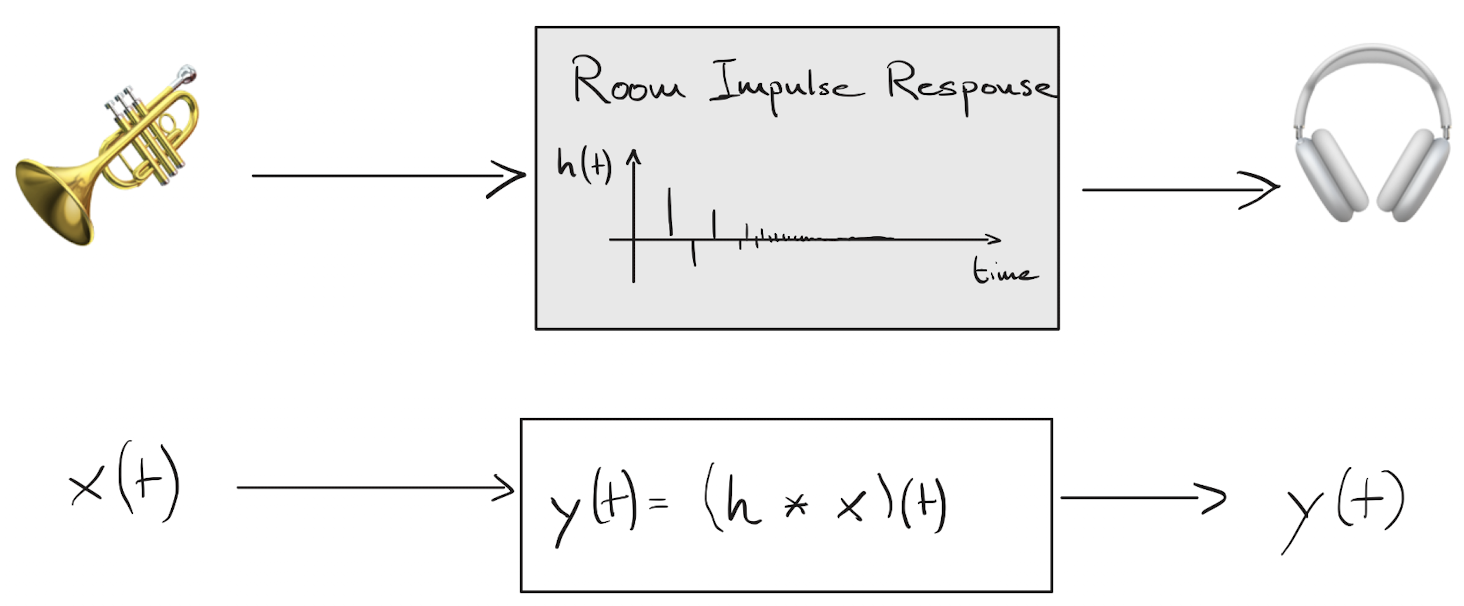
A typical virtual acoustics rendering pipeline consists of several stages:
- Scene description: Defining source and listener positions, room geometry, and material properties
- Acoustic simulation: Computing how sound propagates from sources to the listener
- Signal processing: Applying delays, filters, and spatialization
- Rendering: Converting processed signals to audio output (binaural, ambisonics, or loudspeaker arrays)
2.4 Assignments Overview
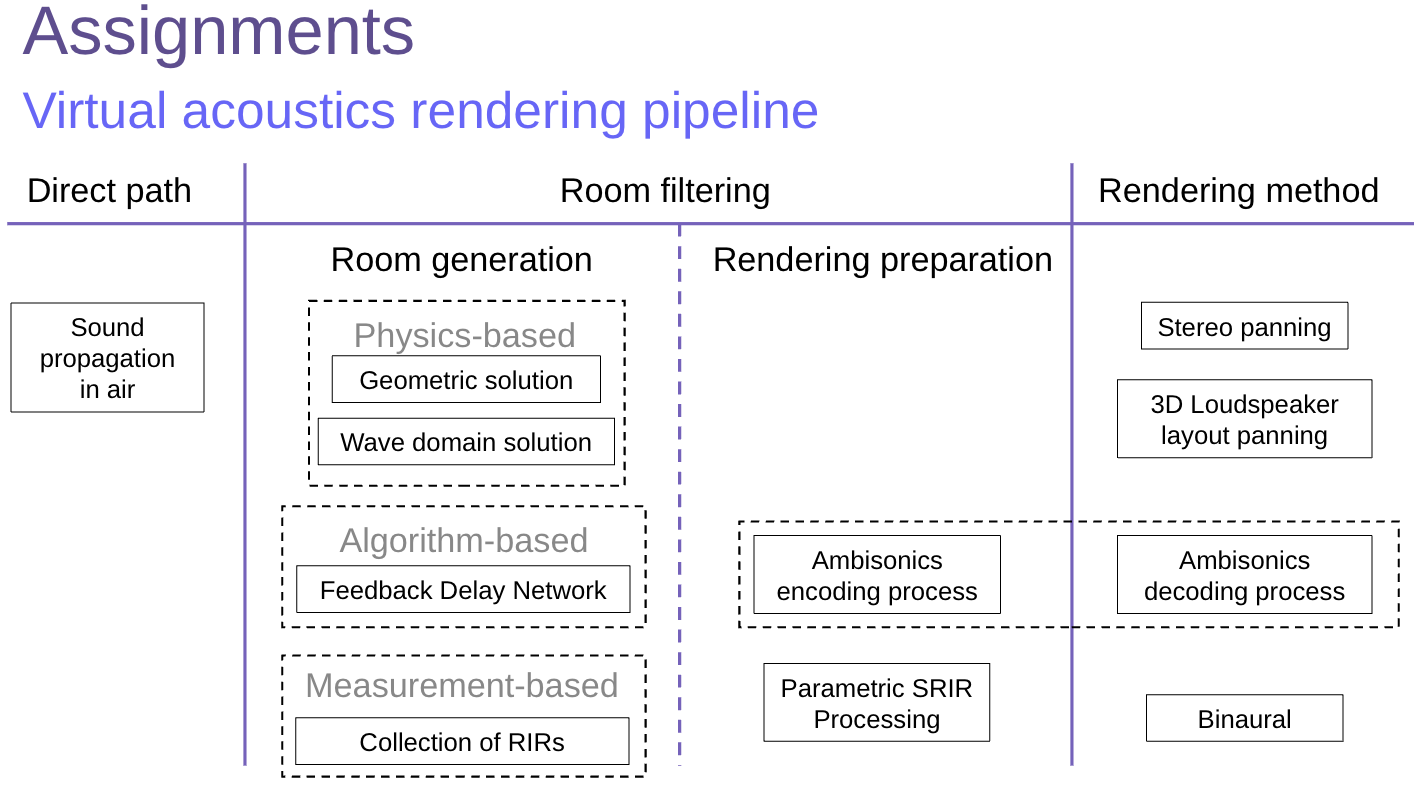
Each assignment introduces a part of the virtual acoustic pipeline:
- A1 (Sound Propagation in Virtual Acoustics) - Free-field propagation
- A2 (VBAP/HRTF) - Spatial audio rendering
- A3 (Ambisonics) - Spatial audio capturing and rendering
- A4 (Architectural Acoustics) - Architectural acoustics
- A5 (Artificial Reverberation) - Artificial reverberation
3 Supporting Materials
The following materials are supplementary to the lab course:
For an introduction to Python Programming Language and its usage in Signal Processing please see the book Preparation Course Python (PCP) Notebooks by Prof. Meinard Müller.
For an introduction to the pyfar (python packages for acoustics research) Python library please refer to the Pyfar Documentation.
4 Literature
The following list of books are supplementary background reading for this lab course.
Auralization: Fundamentals of Acoustics, Modelling, Simulation, Algorithms and Acoustic Virtual Reality by Michael Vorländer
This book provides a comprehensive introduction to the theory and practical applications of auralization—the process of generating audible sound fields based on computer models. It is particularly appropriate for students and researchers interested in room acoustics, audio technology, and virtual reality.
Springer LinkCommunication Acoustics: An Introduction to Speech, Audio and Psychoacoustics edited by Ville Pulkki and Matti Karjalainen
Essential for understanding human communication through sound, this book covers topics from the basics of hearing, speech and audio technologies, and spatial sound. It provides clear explanations suitable for both students and professionals in acoustics, engineering, or psychology.
Wiley LinkRoom Acoustics by Heinrich Kuttruff
Widely regarded as a standard reference, this book delves into the principles of sound propagation, absorption, and acoustic measurements in enclosed spaces. It is an essential text for anyone interested in the acoustical design of auditoria, studios, or other rooms.
CRC Press LinkSpatial Hearing: The Psychophysics of Human Sound Localization by Jens Blauert
This work is foundational in the field of auditory spatial perception, offering a thorough analysis of how humans detect and localize sound sources. It is a key reference for psychoacousticians and engineers working on spatial audio systems.
MIT Press LinkAmbisonics: A Practical 3D Audio Theory for Recording, Studio Production, Sound Reinforcement, and Virtual Reality by Franz Zotter and Matthias Frank
This modern text explores the theory and applications of Ambisonics in 3D audio, including practical aspects for recording, production, and reproduction. It is perfect for students, sound engineers, and researchers exploring immersive audio.
Springer LinkDAFX: Digital Audio Effects edited by Udo Zölzer
A comprehensive guide to the theory and real-world algorithms of digital audio effects. The book covers filters, reverberation, pitch shifting, dynamics processing, and more, providing insights for both beginners and experienced audio engineers.
Wiley LinkSpringer Handbook of Acoustics by Thomas D. Rossing
This comprehensive handbook covers all major areas of acoustics, from basic principles to emerging research fields. It includes contributions from leading experts and provides valuable insights for both students and professionals in acoustics, physics, engineering, and related disciplines.
Springer LinkFundamentals of Spherical Array Processing by Boaz Rafaely
This book provides an in-depth introduction to the theory, design, and applications of spherical microphone arrays for spatial audio signal processing. It is an essential resource for students and researchers interested in array signal processing and acoustical measurements with spherical arrays. Springer Link