Linear Time-Invariant (LTI) Systems and WSS Processes
Correlation Matrices for Random Processes
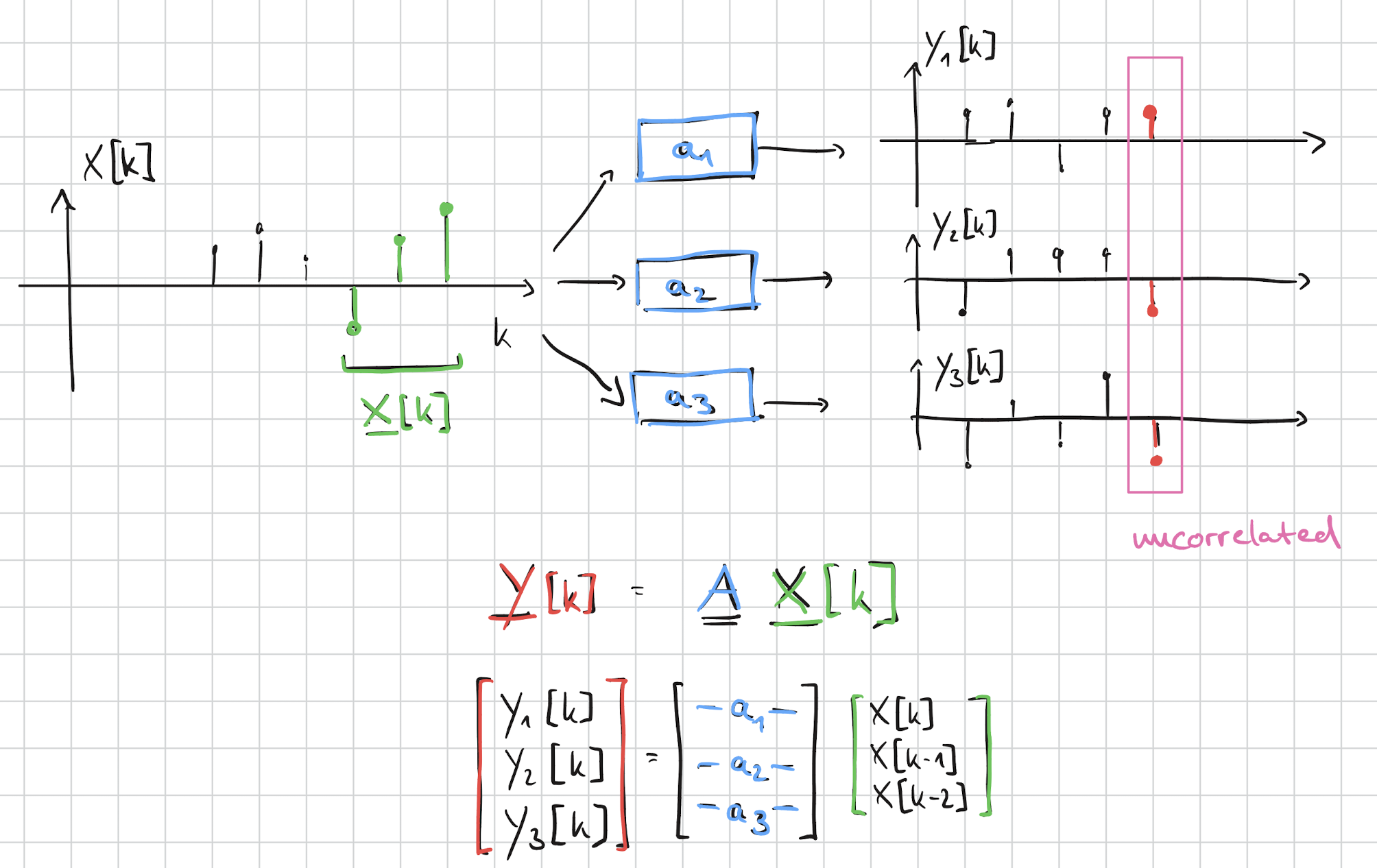
Filterbank Interpretation
Toeplitz vs Circulant Matrix Diagonalization
Application of DKLT
The DKLT can be used to compress the representation of Eigenfaces
Strong vs Weak Properties
For Gaussian processes, weak and strong properties are equivalent (uncorrelated ⟺ independent).
| Property | Strong (Strict-Sense) | Weak (Wide-Sense) |
|---|---|---|
| Stationarity | f_{X[k_1],\ldots,X[k_n]}(x_1,\ldots,x_n) = f_{X[k_1+\kappa],\ldots,X[k_n+\kappa]}(x_1,\ldots,x_n) | \mathcal{E}\{X[k]\} = \mu R_{XX}[k_1,k_2] = R_{XX}[k_2-k_1] |
| Ergodicity | \lim_{N\to\infty} \frac{1}{N}\sum_{k=0}^{N-1} g(X[k]) = \mathcal{E}\{g(X[k])\} for all functions g | \langle X[k] \rangle_k = \mathcal{E}\{X[k]\} \langle X[k]X[k+\kappa] \rangle_k = R_{XX}[\kappa] |
| White Noise | Independent for k_1 \neq k_2 f_{X[k_1],X[k_2]}(x_1,x_2) = f_{X[k_1]}(x_1) \cdot f_{X[k_2]}(x_2) | Uncorrelated R_{XX}[k_1,k_2] = \gamma \delta[k_1 - k_2] |