Discrete-Time Stochastic Processes
Key Concepts
- Random Processes (RPs)
- PDFs, CDFs and Moments of RPs
- Uncorrelated, Orthogonal, Independent Processes, White Noise
- Stationarity and Ergodicity
- Frequency-domain representation
Random Processes
A random process (RP) is a function X[\eta, k] yielding a time-dependent realization x_i[k].
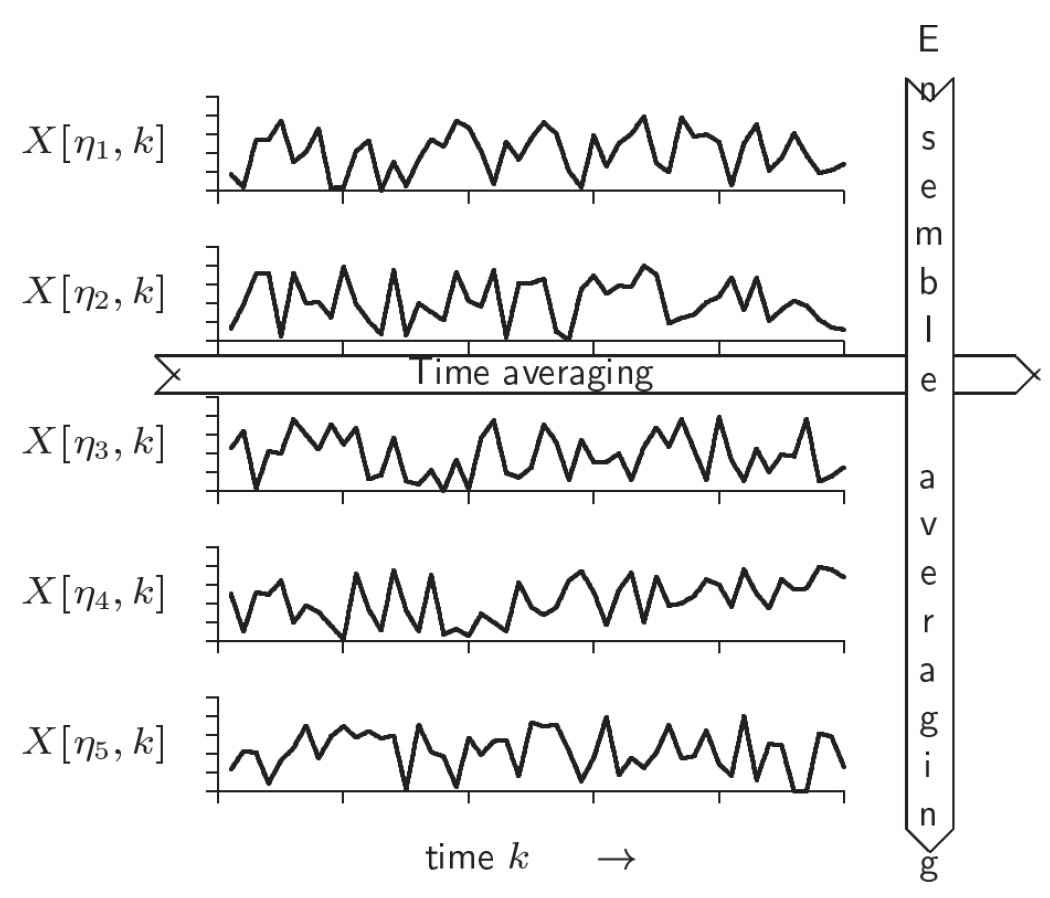
The process is wide-dense stationarity if m_X[k] = m_X, \quad R_{XX}[k_1,k_2] = R_{XX}[k_1-k_2] The process is further ergodic if the time-average is equal to the ensemble average.
Correlation Matrix of Random Processes
Consider a discrete-time random process X[k]. We can extract a vector of RV from this process: {\bf X}[k] = (X[k], X[k-1], \ldots, X[k-N+1])^T
The correlation matrix is then {\bf R}_{\bf XX}[k] = {\cal E}\left\{{\bf X}[k]{\bf X}[k]^H\right\}.
As an example we study the random phase sine wave in noise W[k]: X[k] = \sin( \omega k + \Phi) + W[k] \quad \text{ with } \quad \Phi \sim U[0,2\pi]
Joint Distributions between Time Steps
Correlation Matrix
The process is stationary such that the covariance matrix is described by the covarianaces of the first row.
Weakly White Noise
The RP X[k] is weakly white if C_{XX}[k_1, k_2] = R_{XX}[k_1, k_2] = C_0[k_1] \delta[k_1-k_2]. Whiteness does not imply Gaussianity.
Digital Filtering
A LTI filter turns
- white noise into Gaussian (due to CLT)
- jointly Gaussian to Gaussian
Application: Ergodicity
Ergodicity can be used to estimate the statistical properties of speech
Application of basic decorrelator
Estimating the correlation function based on the ergodicity hypothesis can be done with the following filter: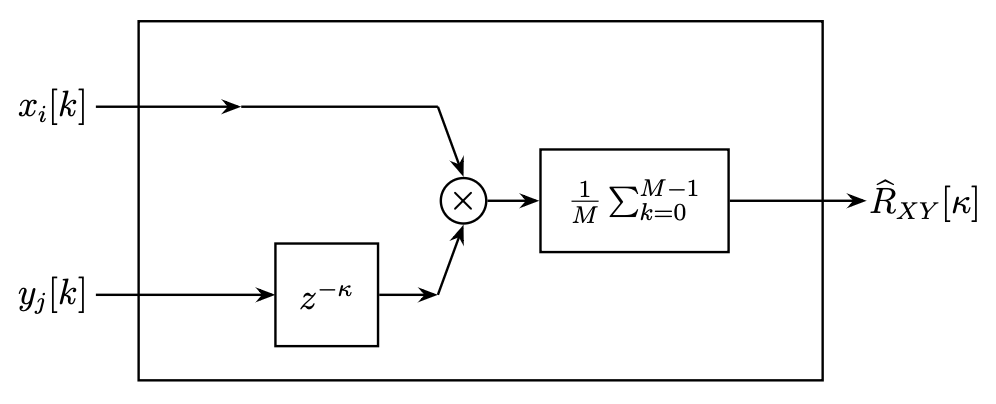
Detection of a sinusoïdal in aperiodic
Consider a measurement Y[k] = X[k] + N[k] of the sinusoid signal X[k] embedded in colored noise N[k].
Measurement of Relative Delay
Frequency-domain Representation of WSS Processes
Application: PSD
The PSD can be estimated to characterize the spectrum of speech.